
Journal
We took receipt paper and turned it into the best-kept secret of our launch.



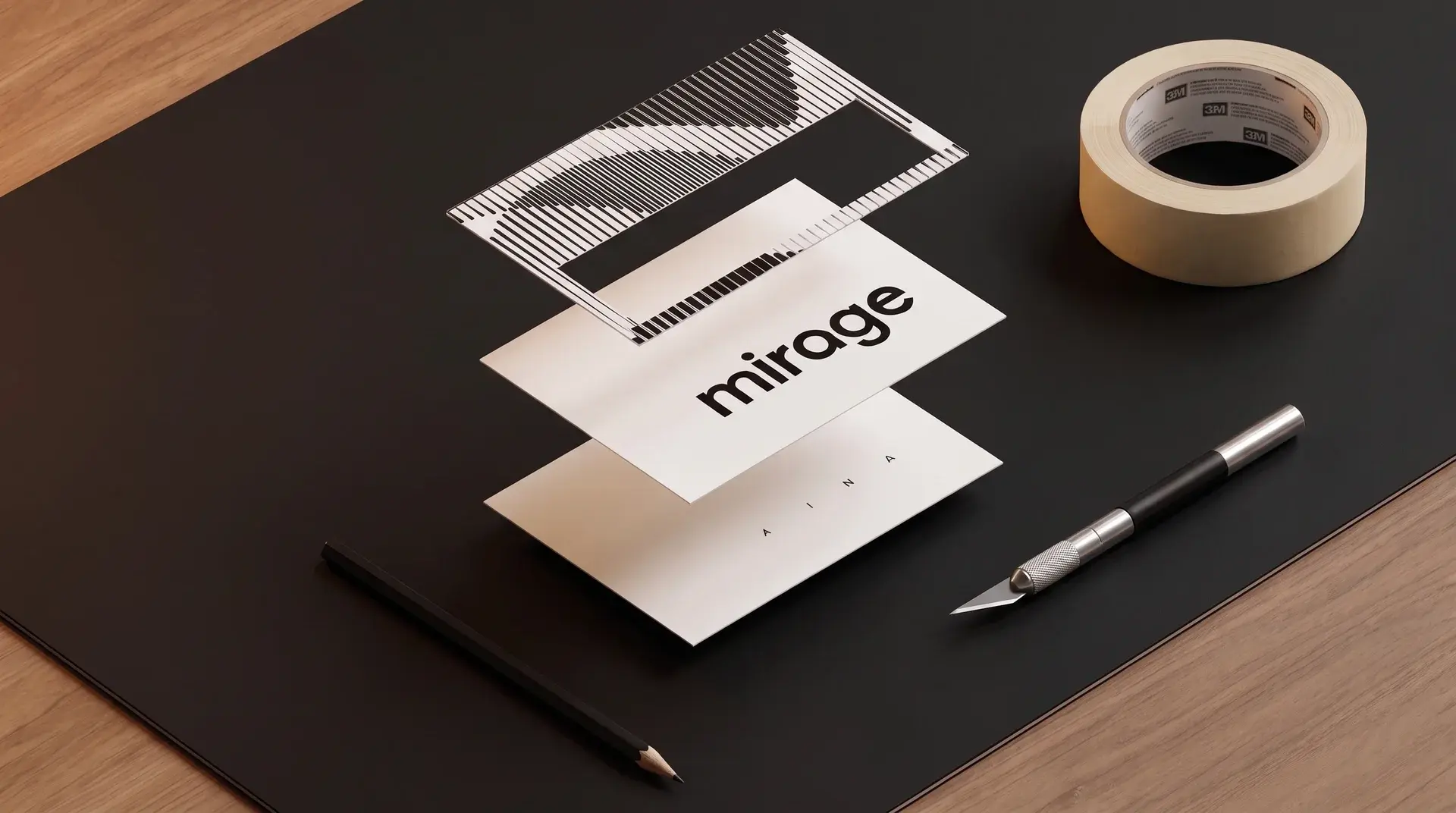
Nobody at CES thought twice about the business card we handed them. Why would they. It’s a business card. You put it in a wallet, you probably lose it in the same jacket for the next two years, you forget the name on it by the time you get back to your hotel room.
At the time, most people had no reason to know the name on it either way. We were still in stealth, running experiments as an HCI lab in Human-Computer Interaction under the codename, Project Mirage.
The name on the card was supposed to slowly reveal our real identity underneath it, Aina, the name we’ve since come out of stealth with.
That’s exactly what we were counting on.
Using a receipt’s oldest trick
Thermal paper doesn’t use ink. Coated onto its surface is a thin waxy layer holding two chemicals apart from each other: a dye that’s colorless in its resting state, and a mild acid. Keep them apart and you get plain white paper. Let them touch, and the acid forces the dye open into a new state, one that suddenly starts absorbing light. That’s the black you see on every receipt you’ve ever thrown away.
The printer has no cartridge. Along its head is a row of microscopic heaters, one for every dot on the page, and each one pulses to about 200 degrees for about a millisecond. Wherever a heater fires, the wax melts just enough to let the two compounds finally touch. That’s the whole reaction. The wax refreezes almost instantly, locking the black in place before it can spread.
The words do not appear because ink was laid down onto the paper, they appear because the printer chose which tiny spots were briefly allowed to react.
That reaction was never permanent to begin with because the two chemicals never actually bond, they’re just held next to each other, and the dye only stays black for as long as it’s touching the acid. Pull them apart again and the molecule goes colorless, and since nothing was ever physically deposited onto the page, the paper simply turns white again.
Heat softens the wax and lets the two drift apart on their own. Sunlight breaks the dye down directly. The PVC in a wallet sleeve seeps into the coating and dissolves the two chemicals aways from each other.
The idea was the easy part
Turning that observation into a shippable business card is a much harder problem than it sounds, and this is the part that doesn’t show up when you’re just holding the finished card in your hand.
The design had to superimpose two completely different printing techniques on top of each other, at pixel-level precision: our real name, Aina, in permanent ink pressed straight into the paper’s fibers, with our stealth name, Mirage, heat-stamped directly on top of it in the exact same reaction a receipt printer uses. Get the alignment wrong by even a little, and “Mirage” doesn’t fully cover “Aina,” or the fade reveals a garbled mess instead of a clean second word.
Thermal stamping and permanent printing are normally two separate workflows run on two separate machines, and nobody we spoke to had been asked to combine them before. But SCPL↗, our packaging partner who we work with for all the crazy packaging ideas we get, took on the challenge

The card itself ended up as a three-layer sandwich: a printed sheet in the middle, sealed between two outer paper layers, with a die-cut window on top exposing exactly enough of the print to show the fade in progress.
Every layer needed to line up almost perfectly, and a meaningful number of early samples got rejected over misalignments that were invisible on a screen and obvious the second you held the physical card.
Close, but not quite

The word "prototype" makes it sound tidier than it was.
These were early experiments, several versions that didn't make the cut, each one failing for a different, oddly specific reason.
Some came out with the print soft at the edges, legible but never quite crisp. Others went the opposite way: dark, high-contrast bases where "mirage" held together under some lighting and dissolved into the material under others. Neither version made it past that stage because the material wasn't behaving the way we needed it to yet.
Getting the size of the graphics right took its own round of trial and error, a word that looked proportionate on screen came out cramped or oddly small once it was actually stamped onto the card.
Heat solved one problem and created another: run it too long or too hot, and too much of the surrounding paper reacted along with the letters, softening "mirage" into something you had to squint at instead of read.
And the paper itself fought back at every stage. Receipt stock comes off a roll, not a flat sheet, which meant fighting a slight curl and inconsistent feed through machinery built for flat-cut paper that had never been asked to run thermal roll stock through it before.
The difference between a version that didn't make it and the one that eventually did came down to something as small as a millimeter of registration, a different heat setting, a base stock that took the stamp differently than we'd expected. It took several rounds of printing, holding each one up to the light, rejecting it, and starting again.
Testing the idea
Before committing to the full production run, we tested the idea in the simplest way we could think of: a batch of cards, left in a refrigerator for a few days, just to watch what happened. The heat-stamped print visibly faded. That was enough to trust that the same process, spread out over real months of ordinary pocket heat and handling, would happen exactly the way we needed it to, without anyone touching a thing.
The cards we handed out cold at CES, January 2026

We handed out these cards at CES in January 2026, while we were still experimenting as an HCI lab in stealth under the codename Project Mirage. Every single card that left our hands that week walked out already carrying our real name, one it hadn't revealed yet, running on a timer none of us needed to manage after the fact.
The cards that did the launching for us
By the time we came out of stealth as Aina in July 2026, a considerable number of cards had already made the switch entirely on their own. A business card is possibly the most overlooked object in professional life, and our design team managed to make people actually hold onto one, watch it, and eventually text a photo of it to a friend, without a single line of code or a single ad behind it. Just paper, heat, and a genuinely good read on a material everyone already carries and nobody ever looks at twice.
